Advantages of Industrial Polyamide Over Metallic Materials
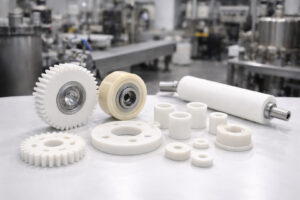
Industrial polyamide, also known as nylon or PA, is one of the most widely used engineering materials in industrial applications that require mechanical strength, lightness, and durability. Thanks to its properties, this material has become an increasingly popular alternative to traditional metal components.
In sectors such as industrial machinery, mechanical engineering, and the food industry, polyamide enables the manufacture of technical parts that offer high wear resistance and lower weight, thereby improving the performance of mechanical systems.
In this article, we analyze the advantages of industrial polyamide over metallic materials and its main industrial applications.
What Is Industrial Polyamide?
The polyamide (PA) is an engineering polymer widely used in engineering due to its excellent combination of mechanical strength, elasticity, and wear resistance.
This material is one of the so-called engineering plastics, designed to withstand demanding operating conditions.
Among its most notable properties are:
- High mechanical strength
- Good wear resistance
- Excellent impact resistance
- Lightweight compared to metals
- Good vibration-damping capacity
These characteristics make it possible to replace metal parts in numerous industrial applications.
Advantages of polyamide over metallic materials
Weight Loss
One of the main advantages of industrial polyamide over metal is its light weight. Parts made of polyamide can weigh up to seven times less than metal parts, which reduces the total weight of mechanical systems and makes them easier to handle and install.
Greater wear resistance
Polyamide offers high wear resistance, especially in applications involving motion or friction. This helps extend the service life of parts and reduce the need for maintenance in industrial machinery.
Vibration and Noise Absorption
Unlike metals, polyamide has a high vibration-damping capacity, which helps reduce noise and improve the performance of mechanisms. This property is particularly useful in industrial machinery or moving mechanical systems.
Corrosion resistance
Another important advantage over metallic materials is that polyamide does not rust or corrode. This makes it an excellent choice for humid environments or applications where metals can deteriorate over time.
Variants by Application
In addition, there are different types of polyamide depending on the requirements of each industrial application:
- PA6: offers a good combination of mechanical strength, toughness, and machinability.
- PA66: It stands out for its greater stiffness, heat resistance, and mechanical properties compared to PA6.
- PA6G (cast polyamide): particularly suitable for large parts due to its high dimensional stability and wear resistance.
- PA with fillers (MoS₂ or glass fiber): technical formulations that enhance specific properties such as wear resistance, stiffness, or friction behavior.
Comparison with other technical plastics
Although polyamide is very versatile, other engineering materials can be used in certain applications. For example:
- POM (polyoxymethylene) when greater dimensional stability is required for precision parts.
- PTFE when an extremely low coefficient of friction or high chemical resistance is required.
- PE1000 (ultra-high-molecular-weight polyethylene) when exceptional wear resistance is required in abrasive environments.
The choice of material will always depend on the working conditions and the requirements of each application.
Industrial polyamide is an excellent alternative to many metallic materials in applications that require strong, lightweight, and durable parts.
Thanks to its combination of mechanical properties, wear resistance, and vibration-damping capabilities, this material helps improve the performance of numerous industrial systems.
Understanding when to use polyamide instead of other engineering materials allows for optimizing the efficiency and durability of industrial components.
Ventajas de la poliamida industrial frente a materiales metálicos
POM plastic. When to choose it over other technical materials
Plástico POM. Cuando elegirlo frente a otros materiales técnicos