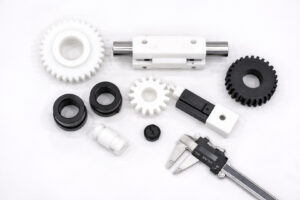
POM plastic. When to choose it over other technical materials
POM (polyoxymethylene) plastic is one of the most widely used technical materials in industrial applications requiring high precision, mechanical strength and low wear. Thanks to its properties, this thermoplastic is frequently used in sectors such as industrial machinery, automotive and mechanical engineering. In this article we analyze when to choose POM plastic over other technical materials such as nylon, PTFE or high-density polyethylene.
What is POM plastic
The POM (polyoxymethylene)also known as Acetal, is a technical plastic designed for demanding mechanical applications. It is characterized by combining:
- High mechanical strength
- Excellent dimensional stability
- Low coefficient of friction
- High wear resistance
These properties make it an ideal material for technical parts subjected to movement or mechanical load.
Types of POM plastic
There are mainly two types of POM:
- POM-C (copolymer)POM-C (copolymer): it offers better thermal and chemical stability, as well as greater resistance to hydrolysis and certain chemical agents.
- POM-H (homopolymer)POM-H (homopolymer): it stands out for its greater rigidity, hardness and mechanical resistance, being especially suitable for applications with high structural requirements.
Advantages of POM plastic
High dimensional stability
POM maintains its dimensions even under mechanical loads, which makes it a perfect material for precision parts.
Low coefficient of friction
One of the most valued characteristics of POM plastic is its excellent sliding behavior, which reduces wear between parts.
High wear resistance
POM is particularly suitable for components subjected to continuous motion or friction, such as gears, guides or bushings.
When to choose POM over other technical materials
Choosing the right material depends on the needs of each application. POM plastic is usually the best choice when parts that combine precision, strength and good wear behavior are required.
It is especially recommended in cases such as:
- Precision mechanical parts
- Components subject to movement
- Replacement of metal parts to reduce weight
- Applications where dimensional stability is required
Comparison with other technical plastics
Although POM is very versatile, in certain applications it may be advisable to use other technical plastics depending on specific needs. For example:
- PTFEindicated when extreme chemical resistance or an even lower coefficient of friction is required.
- Nylon (PA)Recommended for applications requiring high impact resistance.
- PE1000 (ultra-high molecular weight polyethylene): ideal when maximum wear resistance is required in highly abrasive environments.
In addition, compared to materials such as polyamide (PA) polyamide (PA)POM has a very low moisture absorption, which allows it to maintain greater dimensional stability and more precise tolerances even in humid environments.
POM plastic applications
Thanks to its combination of mechanical properties and dimensional stability, POM is used in many industrial sectors. Among its most common applications are:
- Gears
- Bushings
- Slide guides
- Precision mechanical components
- Parts for industrial machinery
POM plastic is one of the most well-balanced technical materials for industrial applications, especially when strong, precise and low-wear parts are required.
Understanding when to use this material versus other engineering plastics improves the performance of parts and increases the durability of industrial components.
PTFE: propiedades, aplicaciones y ventajas en industria
Vantagens da poliamida industrial em relação aos materiais metálicos