PTFE: Properties, Applications, and Advantages in Industry
PTFE (polytetrafluoroethylene) is one of the best-known and most widely used engineering plastics in industrial applications that require low friction, high chemical resistance, and thermal stability. Thanks to its unique properties, this material is used in sectors such as the chemical industry, industrial machinery, food processing, and the automotive industry.
In this article, we examine the properties of PTFE, its main applications, and the advantages it offers over other engineering materials used in industrial settings.
What is PTFE plastic?
PTFE PTFE (polytetrafluoroethylene) is a high-performance fluoropolymer widely used in demanding technical applications. This material is commonly known as the basis for the nonstick coating used on cookware, but in the industrial sector, it stands out for its extraordinary physical and chemical properties.
Properties of PTFE
High chemical resistance
One of PTFE’s most notable properties is its exceptional chemical resistance. This material can withstand contact with a wide variety of chemicals without degrading, making it an ideal solution for harsh industrial environments. For this reason, it is frequently used in the chemical and pharmaceutical industries.
Very low coefficient of friction
PTFE has one of the lowest coefficients of friction among solid materials, allowing parts to slide very easily. This reduces wear between components and improves the performance of mechanisms.
High heat resistance
Another key advantage of PTFE is its ability to withstand very high temperatures without losing its properties. This material can operate continuously over a very wide temperature range, making it suitable for industrial applications where heat can be a critical factor.
Advantages of PTFE over other engineering materials
PTFE is particularly recommended when materials with very low friction, high chemical resistance, and excellent thermal stability are required. Its main advantages include:
- High resistance to chemicals
- Excellent resistance to friction wear
- Low material adhesion
- High stability at high temperatures
These characteristics make PTFE a widely used choice in complex industrial environments and demanding technical applications.
In addition, there are various grades of PTFE formulated to enhance specific properties depending on the application:
- PTFE with glass fiber: improves dimensional stability and wear resistance.
- PTFE with bronze: provides greater mechanical strength and better thermal conductivity.
- PTFE with carbon: increases stiffness and improves resistance to wear and deformation.
Comparison with other technical plastics
Although PTFE has very specific properties, there are other engineering materials that may be more suitable depending on the application. For example:
- POM (polyoxymethylene) when greater mechanical strength and dimensional stability are required for precision parts.
- Nylon (PA) when high resistance to impact or mechanical fatigue is required.
- PE1000 (ultra-high-molecular-weight polyethylene) when high wear resistance is required in abrasive environments.
Each of these materials offers specific advantages depending on the type of industrial application.
Applications of PTFE in Industry
Thanks to its unique properties, PTFE is used in a wide variety of industrial sectors. Its most common applications include industrial gaskets and seals, components for chemical machinery, non-stick coatings, guides and sliding parts, and components for the food industry
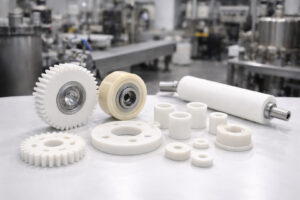
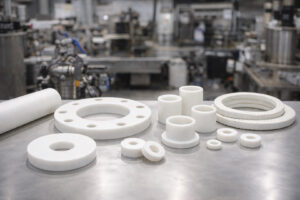
In addition, PTFE is frequently used in the manufacture of machined engineering parts, particularly in environments where other materials do not offer the necessary chemical resistance. PTFE is one of the most widely used engineering plastics in industry, especially when materials with low friction, high chemical resistance, and excellent thermal stability are required.
Understanding the properties of PTFE and its applications makes it possible to select the right material for each project, thereby optimizing the performance and durability of industrial components.
Vantagens da poliamida industrial em relação aos materiais metálicos
PTFE: propriedades, aplicações e vantagens na indústria
Ventajas de la poliamida industrial frente a materiales metálicos